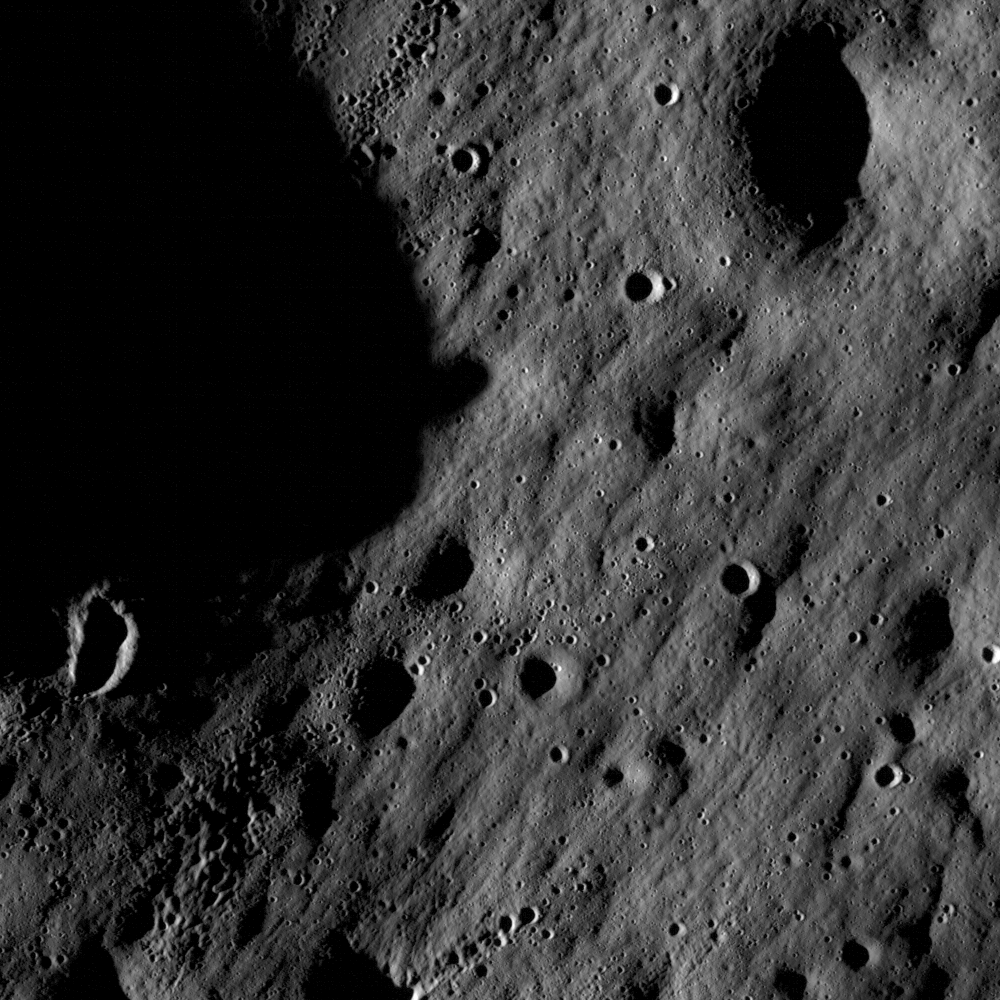
The Lunar Reconnaissance Orbiter is performing exceptionally well and spacecraft checkout is proceeding smoothly. In fact, checkout is proceeding so smoothly that LROC was given an early, but short (two orbits) opportunity Tuesday to measure temperatures and background values while imaging. Since LRO is in a terminator orbit, much of the area photographed was in shadows, which is actually a good situation for performing engineering checks of camera settings. Much to the delight of the LROC Team, a few of the images captured dramatic views of the surface. Browse the whole NAC image below!
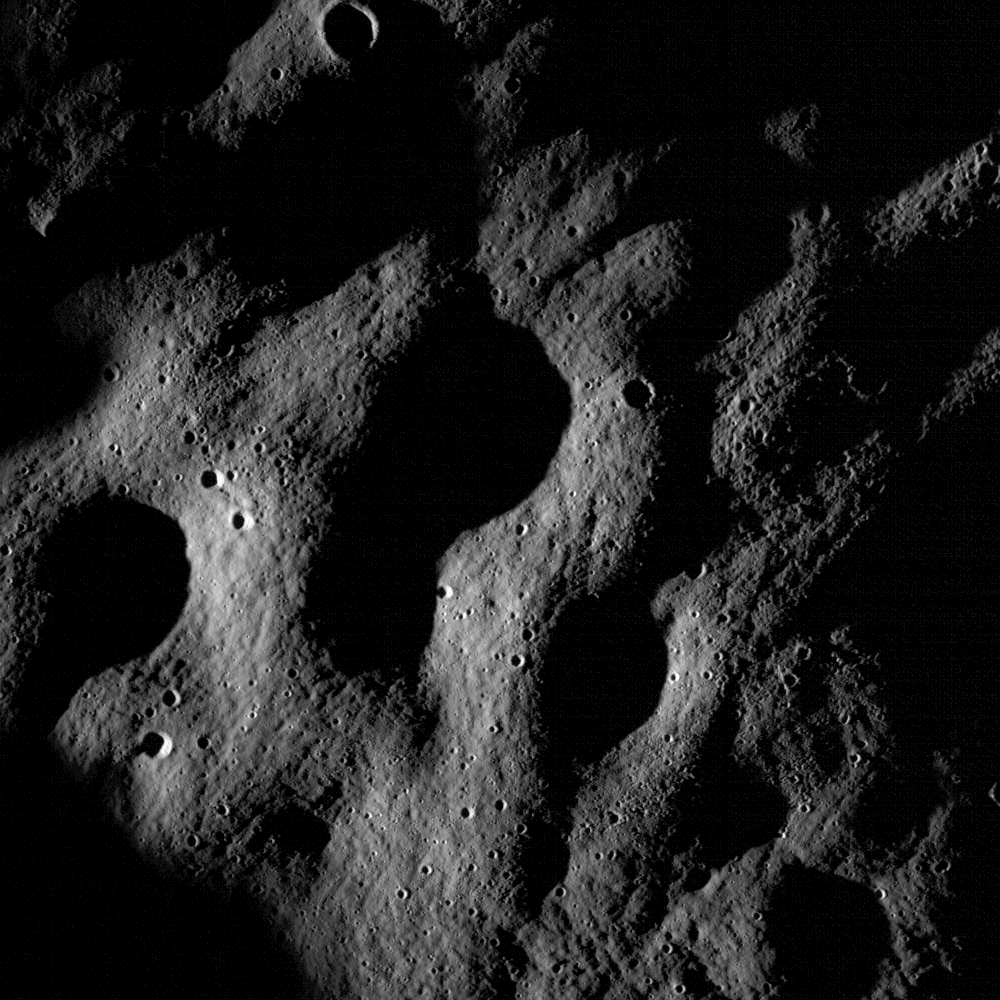
What is summed mode? Along the terminator, there simply is not much light – the instrument is “photon-starved,” resulting in suboptimal signal-to-noise ratios. Or, to put it another way, without summing, images taken in this circumstance would be underexposed. To compensate for low light levels, we can effectively make the pixels larger by summing adjacent pixels to increase the signal-to-noise ratio, making the image sharper, though with 2x lower resolution. Browse the whole NAC image below!
At this resolution, features as small as three meters wide can be discerned. You see here a starkly beautiful region a few kilometers east of Hell E crater, which is located on the floor of the ancient Imbrian-aged Deslandres impact structure in the lunar highlands south of Mare Nubium. Numerous small, secondary craters can be identified, including several small crater chains. Also identifiable are distinctive lineations made readily apparent by the lighting conditions, which are probably remnants of a catastrophic deposition of ejecta from a nearby impact. The quality of these early engineering test images gives us confidence that the LROC Science Team can achieve our primary goals, including obtaining the data needed to support future human lunar exploration and utilization.
The best is yet to come! Once LRO finishes commissioning operations and enters its 50-km x 50-km mapping orbit, a maneuver currently scheduled for mid-August, the LROC NAC will take images over 8% of the Moon at 50-cm/pixel.
LROC WAC: Seeing the colors of the Moon

The LROC WAC represents a very different type of imaging system than the NAC. The WAC sees the surface in seven colors, one after the other. Looking at the raw image is akin to looking through venetian blinds, which is a little confusing at first. First you notice the five stair step-like visible bands, and then the two lower-resolution and barely visible ultraviolet bands. During processing, these seven bands are pulled apart and seven single filter mosaics are created that can be combined in various combinations for scientific analysis. The WAC is designed to help place the super-high-resolution NAC images into their proper geologic context, as well as discriminate color units on the surface to help geologists map rock types and identify resources. Acquired at the same time as the NAC image, more of the Deslandres region is visible because the WAC has a field of view twenty times wider than the NAC though with substantially lower resolution. For comparison, the width of the NAC image is here shown as two vertical bars in the center. The WAC image shown here has not been calibrated and the pixel values were stretched to enhance contrast. Browse the whole WAC image!
LROC is scheduled for activation on Friday July 3rd to formally begin its commissioning activities. The LROC Science Operations Center plans to steadily release exciting images of the lunar frontier as more data is collected and processed.
LRO will spend the next year gathering crucial data on the lunar environment that will help astronauts prepare for exploring the Moon and eventually leaving the Earth-Moon system for voyages to Mars and beyond.
Published by Samuel Lawrence on 2 July 2009