Lunar Reconnaissance Orbiter Camera
  • Home
    • News & Announcements
    • Featured Images
    • Operations Journal
    • Targeting Tool
    • Ask a Question!
    • LRO Live! (videos)
    • Where is LRO?
    • Site Map
    • RSS Feed
  • What is LROC
    • What is LROC?
    • Mission Overview
    • LROC Summary
    • Objectives
    • Specifications
  • Images
  • Downloads
  • Outreach
    • Operations Journal
    • Ask a Question!
    • LRO Live! (videos)
    • Where is LRO?
    • Calendar
    • History
    • Explore the Moon
    • Educators
    • Students
    • Our Team
    • Press Kit
    • Press Archive
  • Tours
    • Tour Information
    • Arrange Tour
:: Homepage ::
:: "Bright Crater Rays and Boulders" by Jeff Plescia « Featured Image « LROC News System ::

Bright Crater Rays and Boulders

LROC News System

Monday, August 3. 2009

3Aug

Bright Crater Rays and Boulders

Featured Image

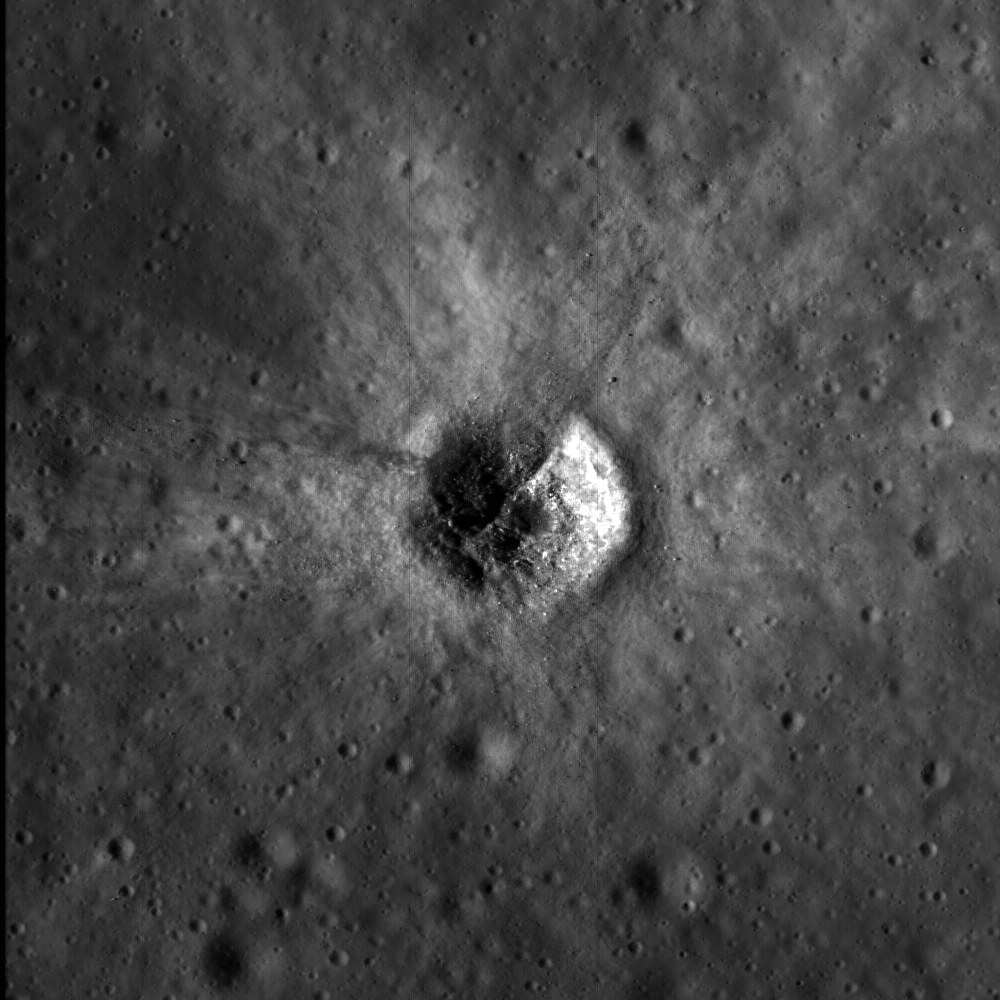
Small (250 m diameter) fresh impact crater surrounded by an asymmetrical bright ejecta blanket [NASA/GSFC/Arizona State University].


High reflectance ejecta usually indicates a young age for the crater's formation, or at least young for the Moon (less than 500 million years). Over time, ejecta blankets such as this will fade and disappear into the background. Since the ejecta is still relatively young, details of its shape are easily seen in this LROC image (1.1 meters per pixel). Close inspection of ejecta patterns help scientists determine dynamics of the impact event. In this case the "V" shaped gap in the bright ejecta shows the impactor came from the northwest at a very low angle.


The floor of the crater has numerous blocks as large as 13 meters that may be pieces of bedrock excavated from below the regolith (lunar soil); or they may have formed as a result of the impact.  This type of boulder can be thought of as "instant rock", because under the extremely high pressure produced by an impact the loose regolith is consolidated into a coherent block or boulder. Apollo astronauts discovered these instant rocks (or regolith breccias) at several locations, with perhaps the most notable being Van Serg crater at the Apollo 17 landing site. Image is 1100 meters wide, north is up, subarea from uncalibrated NAC frame M103138324L. View the whole NAC frame in full resolution (M103138324L).

Posted by Jeff Plescia in Featured Image at 18:35
Comments (0) | Trackbacks (0)
New System Links
  • News System Home «
  • Announcements «
  • Featured Image «
  • Operations Journal «
  • RSS Feed «

Quicksearch

Calendar

Back February '10 Forward
Mon Tue Wed Thu Fri Sat Sun
1 2 3 4 5 6 7
8 9 10 11 12 13 14
15 16 17 18 19 20 21
22 23 24 25 26 27 28

Categories

  • XML LROC
  • XML Announcements
  • XML Featured Image
  • XML Operations Journal


All categories
Goddard Space Flight Center Space Exploration Resources Adler Planetarium Arizona State University, School of Earth and Space Exploration
Comments and suggestions can be emailed to: lroc_webmaster@asu.edu